The Approach
What does it mean to rethread an experience?
The project draws from African American traditions of quilting and needlework, feminist approaches to data, and Black feminist thought to explore what happens when we take an experience apart, follow its threads, and put it back into the world in another form.


How it works
One experience becomes many things.
A participant begins with something that happened. Reflection helps them pull at its threads. What emerges is held in several related forms rather than reduced to a single representation.
Experience
Something happens with or through technology.
Reflection
The survey helps a participant revisit and interpret what happened.
Structured data
Selected responses create information that can be explored across contributions.
Participant language
People contribute their own vocabulary, expressions, and ways of understanding.
Story
The participant's narrative preserves meaning that categories cannot fully hold.
Quilt square
Parts of the response are translated through a shared visual language.
Archive
The forms remain connected as parts of one contribution.
Patterns
Relationships become visible across distinct experiences.
The experience is not converted into one definitive record. Story, data, participant language, and visual representation remain distinct while the archive holds their relationships together.
Making as a way of thinking
The lens is more than visual.
Quilting and needlework offer another way to think about how stories, data, and technology can be constructed.
A quilt is assembled rather than rendered seamless. Individual pieces retain their differences while becoming part of something larger. Threads connect things, but they can also be followed, pulled apart, repaired, added to, or worked again.
Rethreading brings some of those ideas into the way the project collects stories, creates data, builds its archive, and designs its software.
An experience can be revisited.
A story can reveal threads that were difficult to see while it was happening.
Parts of a story can become data without the data becoming the whole story.
Individual contributions can form patterns without becoming interchangeable.
The structures holding those experiences can themselves be examined and made differently.
Ideas brought into the project
What the design tries to hold.
These ideas shape both the participant experience and the technology built around it. They are not a checklist or a fixed methodology. They are questions the project returns to as it is made.
Lived experience can produce knowledge.
An encounter with technology can reveal how a system behaves, where power sits, how people navigate it, and what alternatives they imagine.
Storytelling is a way of making meaning.
Participants do more than report what happened. They return to an experience, notice different parts of it, and tell the story with the benefit of reflection.
People bring their own language to the record.
Bespoke responses let participants use their own words, vocabulary, expressions, and ways of describing what happened.
Data is made, not simply collected.
The questions asked, choices offered, and language contributed all participate in turning experience into information that can be organized and interpreted.
Context matters.
Structured data can reveal patterns, but it can also strip away meaning. Categories remain connected to the stories and language that produced them.

Difference can remain visible.
Like pieces within a quilt, individual stories can remain distinct while their relationships make something larger visible.
People should retain agency.
Consent, visibility, attribution, revision, and withdrawal are treated as design questions rather than administrative details.
Systems can be reworked.
Categories, interfaces, archives, and data structures are human decisions. They can be examined, questioned, repaired, and made differently.
From story to quilt
A pattern emerges without erasing the pieces.
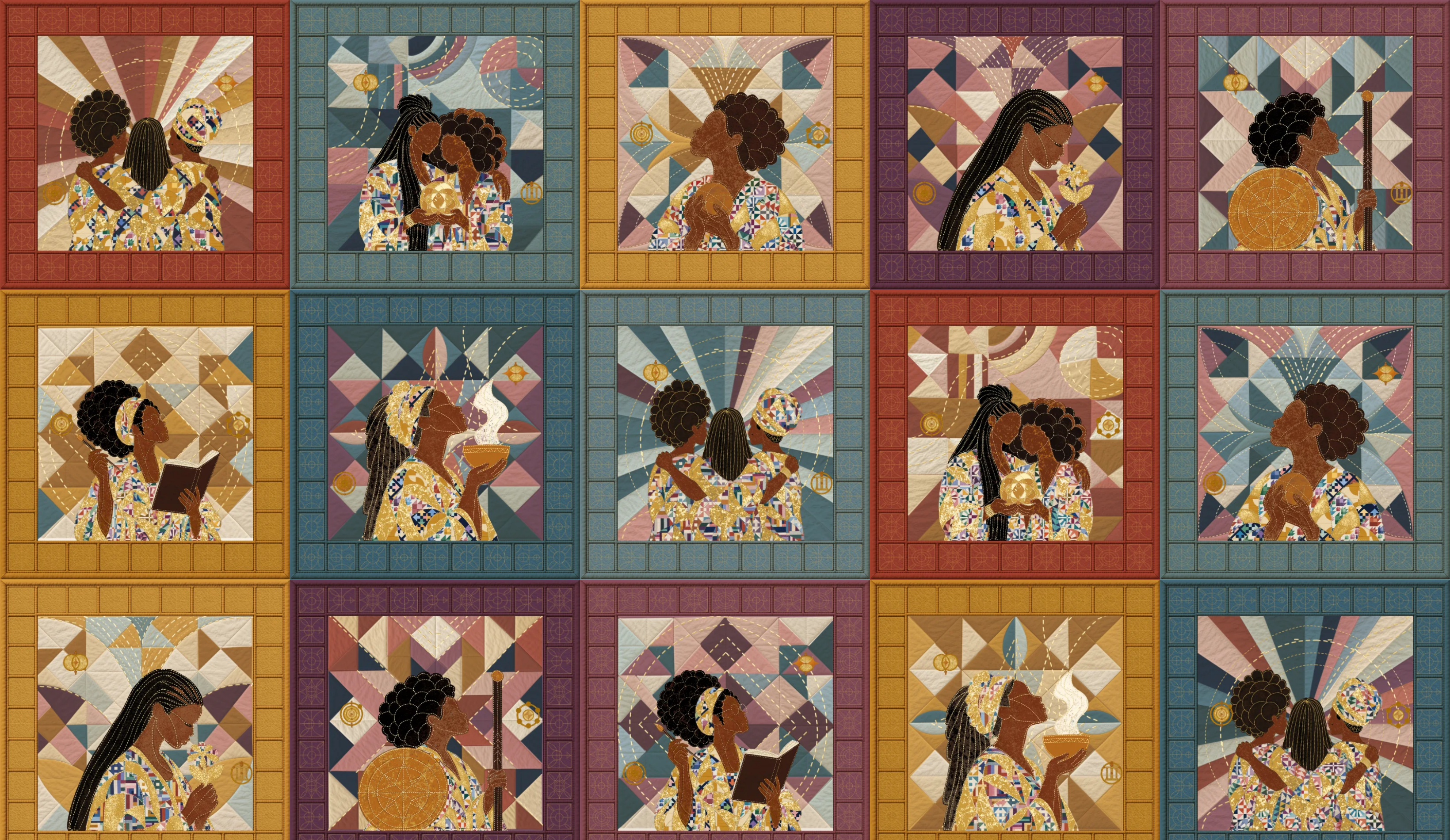
Each participant's responses contribute to a unique digital quilt square. Color, pattern, composition, and other visual elements correspond to different parts of the survey.
Shared rules give the squares a common visual language, while each participant's combination of responses produces something distinct. The quilt is therefore more than an illustration of the archive. It is another representation of the data.
The Archive
Follow a thread without losing the story.
The archive brings together the story, structured responses, participant language, and quilt square associated with each contribution.
Search and filters make it possible to move from a pattern to the stories that produced it, from one story to others that share a thread, or from participant language to other places where similar ideas appear.
Why "Rethreading"?
Three threads in the name.
Rethreading describes what happens to an experience, what happens when many contributions enter a collective record, and what the project asks of technology itself.
Rethreading the experience
Reflection and storytelling let a participant return to what happened and follow its threads: what mattered, who was involved, how they responded, what they came to understand, and what they imagine now.
The experience does not change. Its interpretation can.
Rethreading the collective record
Structured responses, participant-created language, stories, and quilt squares become a collective record. One contribution may echo another, contradict it, complicate it, or reveal something neither could show alone.
The record is not entirely predetermined. It changes as people contribute to it.
Rethreading the technological record
Technological systems already create traces about us: interactions, classifications, profiles, predictions, and data points.
Rethreading creates another kind of record, one people help interpret.
The software is part of the experiment
Small decisions shape the record.
The ideas behind Rethreading do not sit outside the technology as a statement of values. They influence how the project itself is built and create an obligation to revisit those choices.
If participant language reveals that the existing taxonomy cannot hold something important, the taxonomy should be open to reconsideration. If a category obscures more than it reveals, it can be changed. The system is not treated as finished simply because it has been built.
A recursive experiment
The thread can return to technology.
- Step 1 of 7Technology shapes an experience
- Step 2 of 7A person reflects on that experience
- Step 3 of 7Reflection produces story, language, and data
- Step 4 of 7Those contributions enter a collective record
- Step 5 of 7Relationships and patterns become visible
- Step 6 of 7The record changes how technology can be understood
- Step 7 of 7That understanding can inform how technology is imagined and made next
The Next Thread
What should sharing your data feel like?
Rethreading the Algorithm doesn't only ask people to reflect on their encounters with technology. The archive itself is an opportunity to create a different kind of digital experience, one where sharing information comes with meaningful agency, visibility, and choice.
Future versions will explore what that can look and feel like in practice: seeing what you've contributed and what happened to it, correcting it, taking it with you, deciding how long it stays in the archive, requesting its deletion, and seeing the relationships it forms with other contributions.
Some of these features take inspiration from data rights established through privacy laws such as the GDPR. Here, those ideas become interactions people can experience and use, rather than rights described primarily through policies and legal language.
The archive is not just where the research lives. It is also a prototype for the kind of relationship with data that the project asks us to imagine.

NOW
I can see it.
Storytellers can return to see what they shared, including their story, responses, participant language, quilt square, and how their contribution appears in the archive. Sharing something does not make it disappear into the system.
NOW
I can see what happens to it.
Storytellers can follow what happened to their information after they shared it: what I said → how it became structured data → how that data shaped my quilt square → how it appears in the archive. Transformations that usually happen invisibly become visible and understandable.
NEXT
I can change it.
Storytellers can correct information and revisit choices they made when contributing. Submitting something does not have to mean giving up the ability to correct, update, or reconsider it.
NEXT
I can take it with me.
Storytellers can download their contribution in a useful form, potentially including their story, responses, participant language, quilt square, and relevant metadata. The archive is not the only party able to possess and use what was contributed.
NEXT
I can decide how long it stays.
Storytellers can decide how long the archive should care for their contribution. Retention becomes a visible participant choice rather than an invisible institutional policy or an assumption that everything should be kept forever.
NEXT
I can withdraw it.
Storytellers can change their minds and ask for their contribution to leave the archive or be deleted according to the project's deletion practices. Withdrawal is treated as an expected part of the relationship rather than an exceptional request.
LONGER TERM
I can see what it becomes connected to.
When someone encounters a story and responds with a reaction or another story, the archive can preserve that relationship. Storytellers can see the lineage that develops around contributions and follow the threads connecting stories to one another.
LONG TERM
I can influence how the technology is designed.
Explore ways participants can influence not only their own record but also how the archive's categories, relationships, interpretation, and stewardship evolve.
The thread continues
The thread does not end when a story enters the archive.
It can be followed, questioned, interpreted, picked up by someone else, and rethreaded again.